Showing posts with label Annapurna. Show all posts

Tuesday, 30 October 2012

Ghorepani

Shortly after we took occupation of our newly built house on Simbithi Estate, we discovered that, in addition to being homeowners, we were the proud new proprietors of a burgeoning dagga plantation.  When I asked a friend in the building trade where he thought it had come from, he said it was not uncommon to have dope growing in the gardens of newly built houses.  It is the builders themselves who apparently sow the seed when they carelessly discard their joints.  Naturally we never harvested any of it but for a time it was the biggest concentration of weed I’d ever seen.

Until, that is, I went to Nepal.  The groves of marijuana that thrive in the Ghar Khola Valley are so dense and prolific that if this biomass were to spontaneously combust for some reason, the only thing which wouldn’t get high would be the mountains themselves.  The weed, so far as I could tell, is traded with dealers in Kathmandu, sold independently to trekkers and even used by the lodges to spice up the local cuisine (by request naturally).  There was a lot of other vegetation too – fantastic forests of Rhododendron and blue pine, exquisite orchids and other species the names of which now elude me.

A friend who’d done the circuit in 2010 told me that this side of the mountains (Chapter 2 as I referred to it earlier) had not really impressed him.  “It’s not the real Himalaya and is too much like the hills on the outskirts of Durban,” he said.  While I don’t agree with him, I use it now as a provocation to define the unique differences between the two sides of the mountain range.

Chapter 1, the trek from Syange to Jomsom was, at least for me, less a place than it was a state of mind.  As an impressionable 9 year old, I remember reading and re-reading Herge’s “Tintin in Tibet”.  The comic strip made me drunk with dreams of my own Himalayan adventure.  A small rocky hill behind my grandparent’s house in Salisbury served as the ideal prop for this fantasy.  After school I would shoulder my canvas rucksack and head out on my own imaginary summit missions.  Though the summit of Annapurna is invariably tackled from the southern side of the circuit, the proximity to those great mountains made Chapter 1 a fruition of those childhood fantasies.  This was the world that had seduced the likes of Bonnington, Lachenal, Herzog and other intrepid climbers.  It was the world of Yak trains, high mountain meadows and the exotic animals that graze upon them.  It was also the world of Tibet, or at least of Tibetan influence – a fair facsimile for the vivid portrayals which Heinrich Harrer so beautifully captured in his classic book, “Seven Years in Tibet”.  If the area wasn't in the flight path of such massive change, I would have no problem describing it as a sort of Shangri La. 

Chapter 2 on the other hand – the stretch from Tatopani to Nyapul – was an anthropological immersion in the ancient ways of a people.  It was about charming bucolic hamlets, ancient rice terraces and cobbled walkways.  Of people living cheek by jowl with their animals – goats, cattle, chickens, ducks and buffalo – of the sweet homely smell of dung.  For 5 days, it was as though we had been parachuted into an exquisite diorama, the life’s work of the world’s greatest anthropologist.


These young guys were pretty good volleyball players - though the ball kept disappearing down the slope


*
As we headed up the valley, we heard the telltale whup-whup of helicopter rotors echoing in the distance off the valley walls.  We watched as the red and white Bell Ranger chopper descended in every tightening circles into Tatopani.  Ten minutes later, we were on tenterhooks as the machine laboured sluggishly up the Ghar Khola.  The six of us raced to the top of a nearby shrine and raised our poles in final salute.  Hemmed into the valley without a cell phone signal, it would be nearly three days before we could learn of Sandra’s condition.

Two hours later we stopped for lunch at a teahouse in Ghara (Nepali for “beehive”).  It was a tiny shack with a lovingly maintained garden and a God’s eye view of the Kali Gandaki River.  The air throbbed with the humming of bees and we ate piping hot cornbread and freshly harvested honey.  Raj, who had stayed behind to supervise the evacuation caught up with us there.  He had been trekking hard uphill for the last three hours without a break.  That night we slept half way up the valley in a tiny village called Shikha.  We were the Lodge’s only guests so each was assigned their own room, a fantastic luxury even given that mine had a resident chicken.  The view from my window offered sweeping views of the valley through which we’d climbed and was a great vantage point to observe the unhurried ebb and flow of village life.  After dark we climbed up to the rooftop and gazed up at the Milky Way.  To see the night sky like this is becoming an increasingly rare treat these days and with the moon still to rise, it looked a lot like someone had spattered the black ceiling of space with a white paintbrush.  

The following day, we continued our ever-steepening climb through the valley.  Here, women in traditional dress were harvesting crops and feed for their animals.  There, men and boys as young as 13 were hefting massive head loads back to their primitive storage areas.  With the seasons quickly changing, the community was locked in a unified effort to lay up enough food for winter.  It was late afternoon when we arrived in the tourist hub of Ghorepani, a village arranged precariously around the intersection of two valley ridges and which sits in the lee of the famous Poon Hill.  

We arrived in Ghorepani as the trekking season kicked into high gear.  The area (2860 metres) is immensely popular with people who don’t have much time to spare and who aren’t keen on the hardships of altitude.  A 4-day circuit out of Pokhara affords tourists good exposure to these exquisite valleys and the mandatory dawn patrol up Poon Hill offers one of the region’s most spectacular Himalayan panoramas.  The age profile of trekkers here is considerably older than it is on the other side of the mountains while ethnically, Chinese and Korean visitors predominate.  

We stayed in a large boarding establishment that slept nearly 200 people – but which had only two toilets and showers.  This inconvenience was countervailed by the lodge’s excellent restaurant whose kitchen staff even went as far as preparing a delicious birthday cake for Lil.

I spent the afternoon browsing the town’s book exchanges.  No matter where I looked, I was interested to see that the same titles kept cropping up.  I concluded that most travellers come to Nepal on some sort of search.  The nature of the search is often hinted at in the books they read.  Very crudely and in no particular order, the most popular titles are as follows:

1. Into Thin Air – John Krakauer
2. Into the Wild – John Krakauer
3. The Alchemist – Paulo Coelho
4. Shantaram – Gregory David Roberts
5. The Shack – William P. Young
6. The Snow Leopard – Peter Matthiessen
7. Siddhartha – Herman Hesse
8. The Long Walk to Freedom – Nelson Mandela
9. Seven Years in Tibet - Heinrich Harrer
10. Anything by the Dalai Lama

We had a miserable night.  The walls between our rooms were paper-thin and the raucous splutter of farts and throat clearing could be heard from as far afield as three rooms away.  Unrested, we awoke at four o’clock and climbed the trail to the crest of Poon Hill.  This, if the groups of puffing trekkers were anything to go by, was an ordeal for most.  For us however, having recently descended from 5500 metres, it was a complete breeze and we were amongst the first to reach the summit.  

By 5.30am, the grassy hillock and observation tower was thronging with an excited crowd of nearly 300 people.  A great cheer went up as the sun peeped over the horizon and the clear morning air crackled with the ecstatic whirr of cameras.  As the veil of night lifted, we were treated to a nearly 50 kilometre long panorama that consisted of two of the world’s 10 highest mountains (Dhaulagiri 8172 and Annapurna at 8091m) and a staggering concentration of subsidiary peaks including Gangapurna, Annapurna II, III and IV, the Lamjung Himal – and the curiously shaped Machapuchare (also known as Fish Tail Peak).  Rising from the obscurity of the valleys below, the great white barrier of mountains seemed to float in the delicate morning light.


Besides the fact that we’d lived amidst this splendor for the last nine days, even we were impressed.

Sunday, 28 October 2012

A white knuckle day

The temple at Muktinath is one of the most important pilgrimage sites in the world for Buddhists and Hindus alike.   The structure is also one of the oldest Hindu religious sites in the world and is held up as shining example of the harmony that exists between the two religions.  In the early 1990s, the town only had two hotels.  Today it has more than 15.  The growth is due not only to the rise of tourism but to the burgeoning number of pilgrims who visit the town from as far afield as southern India.  As we passed the temple the previous afternoon, I noticed dozens of motorbikes parked outside its walls.  They act as a shuttle service between the town centre and the sacred shrine and one often sees dignified Indian men and women clinging for dear life to the driver as the bike weaves its way up the dusty high street through the pedestrian traffic.

At breakfast I got chatting to a young English guy who we’d met back in Manang.  Jason had completed the trek from Thorung Phedi to Muktinath in 6 hours, including a 30-minute stop at the summit for tea.  He must have been supremely fit.  We were a far cry from this: our traverse from High Camp had taken our team nearly 13 hours and had exacted quite a toll physically.  The previous evening we’d thus agreed to proceed to Jomsom by jeep where we would travel south by bus to Tatopani.  Dreams of Annapurna Base Camp were now well and truly buried.

The decision also meant that we would be bypassing the ancient fortress town of Kagbeni, gateway to upper Mustang.  I was bitterly disappointed as I was eager to see the region’s unique geography and learn something of its legendary horse culture.  It would have been a poor man’s substitute for a trek into the fabled upper Mustang region itself – a highly sensitive and restricted area that very few people get to see unless they have a lot of time, luck and money.  The area is still, at least to some degree, shrouded in mystery and intrigue.  Politically, it was the setting for the last and tragic stand of the CIA funded Khampa Rebellion that sought to wrest control of Tibet back from China.  Culturally, many of its people continue to live under a highly conservative strain of feudal Bhuddism, very similar to that which prevailed in Tibet before the Chinese took over.  Ecologically, it is the last frontier for a variety of endangered terrestrial and avian species including the Lammergeyer and the Snow Leopard.  A two-week trek permit for this ecologically sensitive area is not only hard to secure but is currently priced at $700.  Visitors must complete a register of all consumables they are carrying in as well as show that they have sufficient butane canisters as an alternative energy source to wood.  Packaging for every item on the register must be checked back in with the authorities upon conclusion of the trek.

It was a short walk down to the western end of Muktinath where we joined the lines for a jeep to Jomsom.  While waiting, I examined a table of black, spherical rocks the likes of which I’d seen on sale the previous evening in the high street.  They turned out to be ammonite fossils, locally known as saligrams and considered by Hindus to be sacred symbols from Lord Vishnu.  The stones are kept in temples, monasteries and households while water in which they have been soaked is drunk daily.  They are also used ceremonially in marriages, funerals and house-warmings and the dying person who drinks saligram-steeped water receives absolution and the right to dwell with Vishnu for eternity.  This brazen selling of saligrams, particularly in such vast quantities, is not strictly compliant with Hindu tradition.  Moreover, when one considers the number of pilgrims and tourists who pass through, the impact which fossil harvest is having on the local environment must be significant.

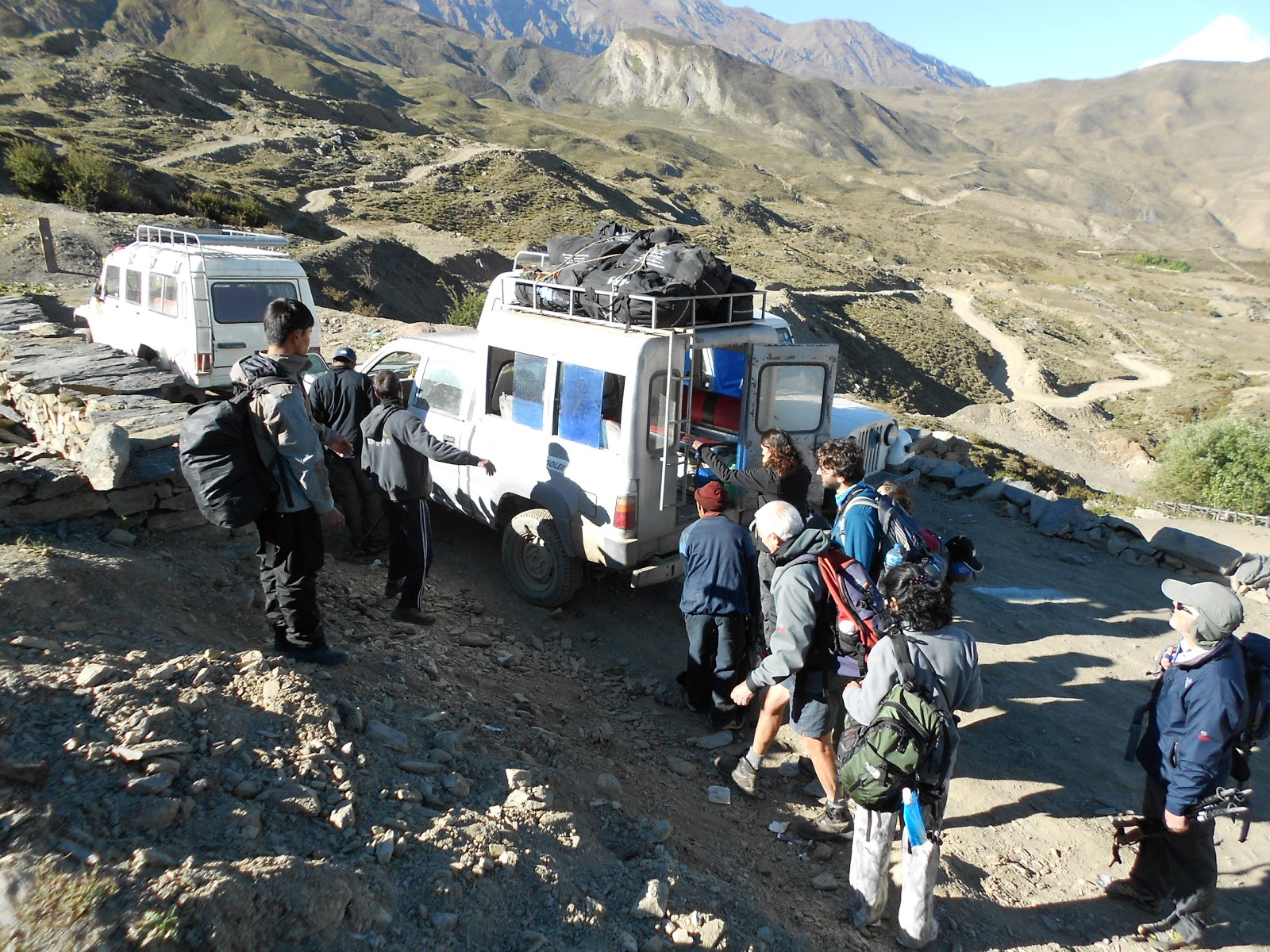
Boarding the Jeep to Jomsom - everyone in picture crammed into that vehicle

Saligrams for sale in Muktinath

In order to fill our jeep, we’d mingled in the dining room of our hotel the night before and recruited trekkers who were as desperate as we were to take some weight off their feet for a day.  Our vehicle thus contained a motley crew of injured travellers and their retinue of guides/porters.  Amongst others, we made friends with an Israeli couple, Nadav and Dana Sherman.  Nadav, a developer for Google in Tel Aviv, was suffering from ITB after the intense downhills of the previous day and could barely alight from the vehicle without wincing in agony.  Dana’s knees weren’t much better.  Seven of us squeezed into the back of the jeep while the remaining 6 sat up front.  Crammed into this confined, tinny space and inhaling a nauseating swill of fine dust and diesel fumes, we rode the waves of motion sickness as the vehicle flip-flopped its way through the 1000 metre descent into the Kali Gandaki Valley.

Admiring the Mountain fastnesses of Lower Mustang - Kagbeni can be seen beyond the apple orchards in the distance

At a lookout point halfway down, we took a break.  Some retched uncontrollably into the bushes while others admired the stony immensity of Lower Mustang.  The river plain combined with its lush apple orchards and surrounding ampitheatre of snow-capped peaks and gravelly hills are so vast that the place almost swallows anything which ventures into its depths.  I felt desperately cheated to be seeing it so fleetingly.  I equally regretted our short stay in Jomsom, a clean and well-ordered town that rests in the shadows of the great Dhaulagiri group.  But we were in such a rush to catch our bus that there was little time to do more than have a quick bite to eat.
*
It is the work of a moment to look at the map and say: “it looks like we can take public transport down to Tatopani – and it shouldn’t take much more than half a day”.  The first time visitor should not be criticized for this:  the road, on the map at least, looks fairly straight and the distance appears short.  

But all this is to ignore the fine print of the contour lines, the seed, (once again in our case), for gross miscalculation.  You’d think we’d have learnt from our grinding ordeal on the trip from Khatmandu to Syange.  In truth, we remained howlingly naïve.  We thus blundered into our rest day blissfully unaware of the adventures that lay ahead of us – of the almost seismic shift in altitude between Jomsom and Tatopani (about 2600 metres over a linear distance of 40 or so kilometres).  Of the inconvenient fact that we were at the tail end of a particularly generous Monsoon and that the hills were as saturated as a wet chammy leather.  Of the woefully slim choice when it came to choosing public transport…

Nepali busses, besides their gay and garish exteriors, must surely rank amongst the most nefarious inventions known to man.  Egregiously maintained, their interiors have been built with the stature of the locals in mind.  On the way to my seat I counted (through painful experience), at least 6 points of interruption between the ceiling and my head.  Furthermore, the coaches have the most rudimentary of sound systems that pipe an incessant and grating cacophony of weird and wonderful Hindi and Nepali music into the cabin.  

Our bus trundled out of Jomsom at about 11 o’clock heading South into the ever-deepening Kali Gandaki valley to Marpha – where we stopped to buy freshly picked apples.  Marpha’s chief export is apple brandy and I was impressed by the town’s quaint distillery.  As we left Mustang behind us, the barrenness was quickly replaced by imposing stands of pine and juniper.  At three, we experienced the first disruption to our journey.  The road ahead was so bad we would have to disembark, retrieve our luggage from the roof and hike two kilometres to the next town where we would find another bus.  Everything about this changeover seemed fairly routine until we got caught in the mad scrum to board the new bus.  Let’s just say it nearly got violent.

Apple stop at Marpha

Bus change in the Kali Gandaki - The World's deepest Gorge

The second bus journey was a terrifying ordeal.  Though a considerably shorter leg, a vehicle designed to hold no more than 30 passengers now held upwards of 60.  Moreover, the road now descended into the business end of the world’s deepest river gorge.   Often hideously close to the void, our bus seemed to defy the laws of physics as it hared through the bends and switchbacks.  When we disembarked half an hour later I noticed that one of the back tyres had shrugged off its re-tread and was down to the canvas.

What you see here is not dirt but canvas

The relief of terra-firma was short-lived however.  It was nearly five o’clock and the last bus of the day was due to leave the next village in 20 minutes.  If we missed that, we would be forced to camp in the open.  This triggered a desperate footrace through the gorge in which all 70 passengers of the previous bus participated.  The field arrived in the next hamlet more or less as one though just in time to see the bus in question disappearing around the next bend.  A collective groan rose above the village though hopes were restored somewhat when a local trader said he thought another bus would be through at any moment.  

An hour later we were still waiting.  The crowd slowly thinned out as locals returned to their houses and a few trekkers shouldered their gear and headed off down the road to the next village.  We said goodbye to Nadav and Dana.

At 6.30, just as we were entertaining thoughts of our own night hike, a jeep in hideous state of disrepair laboured noisily up the hill.  There was a grinding of gears as it stopped in front of the store.  As the driver emerged, Raj flew hastily into action.  After an animated conversation our guide and the driver disappeared around the corner for a few minutes.  I cannot say what went on there but I imagine a lot of money must have changed hands.  Ten minutes later, the jeep was loaded and we were ready to go.  A pair of young Israeli girls joined us, one of who was suffering from a ruptured eardrum.  We left the settlement much relieved.

As is usual with the roller coaster nature of road travel in Nepal, there were more thrills in store.  I peered through the windshield, seriously obscured by tassels, trinkets, carpeting and stickers of Bollywood actresses.  The night was closing in quickly and visual perception for the next hour would be confined to opportunistic glimpses, mostly as the vehicle tilted to one side.   What I do remember was a waterfall so colossal that I thought I was hallucinating.  If it weren’t for Martin’s cry of amazement at seeing the same thing I would still think it a mirage.  Will I ever behold such an awe strickening sight again I wonder?  It consisted of at least 4 separate cataracts, the last of which thundered into a pool through which the road passed.  From there, the river turned downhill and followed the road.  We drove with water up to the wheel bolts for nearly a full kilometer.

View from the front seat of our jeep

Just as it got pitch dark, our driver stopped the car, turned to me and said: “I’ll on the lights!”  Why, I wondered, the need to stop the car?  It turned out that the lights in question had to be actually fastened ON to the car.  A roll of masking tape was produced and our porters got out to offer advice.  One of our Israeli friends commented that on a previous jeep ride in Chitwaan Game Reserve, the headlights had been so weak that the driver asked his passengers to climb onto the roof and use their headlamps to light the way.  At least in our case it never came to that.

At 8 o’clock, the jeep stopped in the midst of a heavy downpour outside our lodge in Tatopani.  We were too tired and shell-shocked to even feel relief.  At 1100 metres, we were now firmly back in the tropics.  The air resounded with the shrill chirruping of cicada beetles and the angry roar of the river.  The contrast with the past five days was surreal.

Three hours later a bus descending from the village of Rupsecchhahara (where we’d commandeered our jeep) failed to negotiate a decisive bend in the road and sailed headlong into the inky darkness of the Kali Gandaki.  Miraculously the occupants, a driver and his conductor, escaped with their lives.

It could so easily have been us.


Wednesday, 24 October 2012

Rest Day in Manang

We were entering what I consider with hindsight to be the most photogenic crescent of the Annapurna Circuit.  What struck me was not only the sheer diversity of the subject matter but the density of it too - strange and fantastical geological formations, wooded valleys of blue pine and juniper, serene meadows, artisanal wooden bridges spanning rushing rivers.  All this scenic generosity juxtaposed against cobalt blue skies and boiling phalanxes of cloud made the memory of our third day one I will treasure for a long time to come.  


Trekking near the Swargadwari Danda - the photos hardly do this place justice

At the epicenter of this marvelous region was the village of Dhikur Phokhari, immediately recognizable for the gigantic sweep of the Swargadwari Danda – a severe rock face which towers over the town.  It resembled a gargantuan tidal wave which aeons ago was on the verge of pulverizing the valley before the creator uttered the words “this far and no further”.  The 1500 high metre wall was visible for the majority of the walk from Koto to lower Pisang though some of the best views could be seen from the road that meandered through the forest beyond the town.

The day would have been perfect except for the fact that I had a pounding headache by the time we reached Pisang, 3200 metres above sea level.  I made a mental note to escalate my water intake and to commence my course of Diamox that very night.  After checking into the guesthouse, I followed the trail out of town to get a better view of the sunset.  I stood for a while and examined a primitive yet fully functioning aqueduct fashioned from hollowed out pine logs.  It was brimming with fresh water diverted from the river higher up the trail and though ancient was undeniably elegant in its simplicity.  I crossed the river and scrambled up the hill.  On the crest stood a memorial to an ill-fated Japanese expedition that had perished some years ago on the slopes of Annapurna IV.  High above the forest, the peak in question luxuriated in a glorious burst of alpenglow – almost too beautiful to be dangerous.


Dusk outside Pisang

That evening in the dining hall, it was obvious that I wasn’t the only one concerned about the effects of altitude.  Indeed, the higher we got the more fixated about it we became.  We were unanimous that the trail had been harder than anticipated and keenly aware that our progress had been painfully slow.  Stretches which should have taken 6 hours or less to complete were taking 8 hours or more.  But it wasn’t until Raj said that we would need more days to successfully negotiate the Thorung La that things really got really heated.  Some lamented the obvious implications: the trip to Annapurna Base Camp would either be an unpleasant rush or even impossible.  After much debate on how to reset our itinerary, we agreed not to re-visit the issue until our rest day in Manang.  Of one thing we were all agreed however: no one wanted to retrace the trail to Sangye.  There would be only one way and that was up.


The following day, the walk through to Manang was one of the most relaxing we had had to date though conditions were very dusty and the glare off the road’s clay surface intense.  Much as I enjoyed the day, I was irritated to discover when it was too late that there were two routes to Manang and that our guide, assuming we weren’t fit enough for the higher more scenic one, had remained silent on the issue and defaulted us to the tamer route.  It was a Swedish Doctor we met near Humde who let the cat out of the bag, expressing amazement at our choice.  Though she didn’t elaborate, we knew we’d drawn the short straw.  Still, had it not been for this, we would not have been in a position to sample the baked delights of the Humde and Manang valleys where the locals have developed quite an expertise in the fine art of patisserie.  At Humde airstrip we purchased cinnamon buns from an old lady by the roadside and at Braga sampled freshly baked carrot cake.  These items were surprisingly good and a welcome break from the artificially sweetened biscuits that up to now had accompanied our tea breaks.

The Humde Valley - the airstrip is temporarily out of action as they are tarring it - (probably bad news because it will mean more flights and thus more tourists)

Making friends in the Humde Valley


 We arrived in Manang shortly after lunch.  At 3500 metres, the town is a good place to spend a rest day and most trekkers spend two nights there.  Because of this, Manang is a good deal more cosmopolitan than other places we’d stayed.  The cobbled streets are lined with souvenir shops, outdoor stores, book exchanges and a few very good coffee shops and bakeries selling such brands as illy and Lavazza.  The town even has its own movie house that constantly loops the same 6 films.  They are:

“Into the Wild” and “Into Thin Air” (inspired by the John Krakauer books)  
The Nepalese art nouveau classic “Himalaya”, 
The gripping mountaineering docudrama “Touching the Void”, 
“Slum Dog Millinear” (sic) and 
“The Hangover” (of all films!).  


The movie house has its own fireplace, seats covered in Yak hide and guests are served fresh popcorn and hot tea.  It’s all a very nice touch indeed.  Manang is also the headquarters of the Himalayan Rescue Institute, housed in a ramshackle cottage at the entrance to the village.  Here, trekkers can attend free daily talks on mountain sickness and have their oxygen levels tested for $10 a pop.  We attended one such talk and found it both highly informative and entertaining – if not a little unnerving.  

After a good night’s sleep and the prospect of a full day’s rest, everyone was feeling a lot better.  I went shopping and bought trekking poles having neglected to get some in Khatmandu.  Eager to try them out, I convinced Raj and the others to join me on an acclimatizing walk up to Chongkor Point (3800 metres) on the other side of the river.  The point is at the summit of a massive hill that overlooks the Gangapurna Glacier and lake.  

Led by two of our porters, we set off just after breakfast.  The downhill section to the river led through Manang’s primitive stone town where the sanitation was gossamer to say the least.  I quickly named this septic area “poo alley”.  Fortunately the uphill section to Chongkor point was a lot easier than it looked from the other side of the valley and though the views of the glacier and the lake were spectacular, they were alloyed somewhat by the prospect of the descent.  No one was looking forward to a knee pounding – or to the miasmic sludge of “poo alley”.   But in the event we coped just fine.  

Technology comes to the Annapurna Region

Gangapurna Glacier

Amongst Manang’s many acclimatization walks is an excursion to a monastery situated on a barren hillside 800 metres above the village.  The place dates back to mediaeval times and is inhabited by a Buddhist Lama who for the sum of 200 rupees will impart a blessing to his visitors.  A fellow trekker who went there told me that the Lama is 94 years old and that he last came down to Manang more than 30 years ago.  He is attended by his 64 year old daughter who descends to the town once a week to purchase food and other supplies.

The rest day did me good and and though Manang was a bit on the busy side and our hotel a little too grubby for my liking, I found the valley enchanting.  In the rarefied air, the mountains seemed so close you could reach out and run your hand along their icy slopes.  I was also taken by the industriousness of its people and the “all hands on deck” urgency they brought to harvesting the ripened wheat crop.  From before sun up to well after dusk, people of all ages pressed into the challenge associated with cutting, bundling, carrying and threshing.  I suppose the spectacle should have inspired a sermon on Matthew chapter 9!  

The only concern was Sandra’s condition.  Her flu had actually gotten worse in spite of her day’s rest.  Surprisingly, a British doctor form the Himalayan Rescue Institute had given her the all clear to ascend, providing she did so slowly.  Our decision regarding itinerary had practically been made for us.  Our next overnight stop would be Yak Kharka, 400 metres higher than Manang.

The beautiful Manang Valley


Sunday, 21 October 2012

Manang District

I was standing on the bank of a rushing river that flowed perpendicular to a rocky scree.  Somehow the path had petered out and I was wondering where I should cross.  On the far side, a fellow trekker shouted words of caution above the roar… “Don’t try to cross!  Use the bridge further down!  If you cross here you will definitely drown!”  I weighed up his words and decided to ignore the warning.  There was no way I would drown, after all, just how deep could the water be?  No sooner had I thought this however, I remembered a friend who had drowned whilst on a trek in Alaska a few months before.  I remembered my shock at the news and the outpouring of grief from his friends and family.  Even in light of this I decided that the bridge 200 metres below represented too big a detour and that the risk was worth it.  

I waded in.  

In an instant the glacial melt enveloped me and sucked me under.  Swirls of bubbles and eddies of gravel rose up to fold me deeper into the river’s clutches.  The water was suddenly not clear at all.  Instead it was a milky suspension in which there was neither up nor down.  I bounced and rolled downstream, my breath failing.  How long could I hold on?  But then a last sliver of hope – a tree trunk lodged between the rocks.  If only I could grasp it…

I awoke in a chilly veneer of sweat, my head buried deep inside the hood of my sleeping bag.  I was gasping for breath as though I’d been holding it for at least a minute.

Cheyne Stokes breathing.  According to Wikipedia – “an abnormal pattern of breathing characterized by progressively deeper and sometimes faster breathing, followed by a gradual decrease that results in a temporary stop in breathing called an apnea”.  Cheyne Stokes breathing, coupled with hallucinatory nightmares, is a common condition amongst trekkers and climbers who have gained altitude too quickly.   Since setting out from Sangye, we had gained over 1600 metres in two days though technically we weren’t really high enough to be feeling the full effects of altitude.

Such a rapid gain in altitude is generally not a problem below 3000 metres, though cases of altitude sickness have been detected as low down as 2200 metres above sea level.  Higher than 3000 metres however, trekkers are advised to observe something called the “rule of threes” which, simply put, prescribes the following:  over 3000 metres never let your net gain in altitude (between sleeps) exceed 300 metres per day – and every 3 days take at least 1 rest day.  In addition, never drink less than 3 litres of water per day – in fact, try to drink a good deal more if you can.

Complying with the latter injunction is a good deal harder than it sounds in Nepal where, in spite of its surfeit, very little water is fit for human consumption.  In cases of glacial melt, the liquid is too saturated with minerals and extensive filtering is required.  In the case of the deceptively limpid mountain streams one can never rule out the existence of a village somewhere above where one is drawing water.  In fact, it is safe to assume that no matter how high up you may be, there is always someone higher up than you are who is polluting the system.  One may go to bed feeling on top of the world but when morning comes and the clouds have parted, one invariably catches sight of some isolated hamlet clutching tenuously to the hillside higher up.  

In light of my discomfort over the use of bottled water, I found it a constant challenge to keep my Camelbak hydration system suitably replenished.  Also, the higher up you go, the cost of a litre of water begins to spiral radically out of control.  Take bottled water as a yardstick:  in Kathmandu, a traveller can purchase a sealed 1L bottle of ozonated water for as little as 15 Rupees (R1.50).  Now as we entered the Manang district, the same bottle had skyrocketed to 200 Rupees a unit (R20).   A litre of boiled water procured from a tea-house kitchen (by no means a failsafe solution) could cost anything between 100 and 150 Rupees.  Invariably, the answer was to draw water from a nearby spring and treat it with chlorine and a portable UV device called a Steripen.  Another option – by the far the best but not always available – was to buy ozonated water from community run filter stations which a New Zealand non-profit installed recently to combat the bottled water problem.  At 40-50 rupees a litre, this was competitive but a number of these were temporarily closed due to breakdown and lack of spares.  In short, proper hydration was not only a gamble but also a constant preoccupation.

Another challenge associated with water was consuming it in the requisite quantities – and then dealing the obvious implications. Because many teahouses had fewer than 3 toilets, the queues that formed outside these were often sizeable.  This, added to the woeful prospect of a nighttime visit to these noxious pits, meant that many trekkers simply resorted to alternative arrangements.  The result was that the surroundings of many pristine and beautifully appointed lodges smelled overwhelmingly of stale urine.
*
As we walked deeper into Manang district and passed through towns like Koto, Chame, Pisang and eventually Manang itself, we encountered more and more of the Buddhist influence in the lives of the local people.  As we sat down for breakfast in Koto for example, an acrid smoke wafted into the dining room and before long had us choking.  “Sort that bloody smoke out before it ruins my breakfast!” someone shouted rudely at our host.  It turned out the smoke was emanating from a tiny ceremonial burner on the stone wall outside where juniper branches were being burned to ward off evil spirits.  It was a practice we saw frequently over the next week and I became quite comfortable with the fragrance.

Ornate prayer wheels in Lower Pisang - the ancient bronze wheels have been beautifully crafted.  As they break they are often substituted with Nescafe coffee tins


Nepalese Children are very cute indeed!

In addition, a large and ornate Buddhist Chorten heralded the entrance to every town.  A brightly decorated archway containing copper prayer wheels followed soon afterwards.  The expectation was that travellers, pilgrims and residents would spin the wheels as they passed through, thus activating the prayer inscribed on scroll contained within. 


Buddhist Chortens - these should be passed on the left

*
Before leaving SA, I’d read about the region’s much-maligned road building projects and had pushed for a change in itinerary to avoid the worst sections.  Now that we encountered them however, it seemed we’d over-reacted.  A muffled “boom” the previous afternoon had advertised the presence of teams blasting their way along a particularly steep hillside that flanked the river.  But in spite of the use of dynamite, the scale and pace of the effort was so small and slow as to be almost non-existent.  Mostly, we encountered terribly undermanned and ill-equipped construction teams, seldom numbering more than 7 or 8 people, many of whom were feeble children and undernourished teenagers.  We found them in the most unlikely places where almost no geographical feature was too big an obstacle.  Stubborn rocks and boulders that remained after blasting were systematically broken down - first by the application of fire and then the old fashioned way – by hammer.  We encountered dazed, exhausted road builders, shrouded in chalky dust and with gazes so vacant they looked more like phantoms.  Every now and then, we would pass young men, no more than 16 or 17 years old, carrying head loads of fine gravel and sand weighing at least 50kgs.  It’s impossible to say when the road will be complete to say nothing of what its full effects on the area will be.  For now, it is man in his most primal state contending with the greatest mountains in the world.  Will the Chinese soon step in to dramatically escalate the scale of the undertaking?  If so what will remain of the circuit?

This section of road was once a vertical cliff-face.  There's very little that a stick of dynamite can't sort out...

Friday, 19 October 2012

Into the Wild!

We’d been on the road for 2 hours already and had barely cleared Kathmandu’s city limits.  The problem, of course, was that the road simply wasn’t wide enough to contain the huffing, puffing scores of colourfully decorated busses that ply the route between Besi Sahar and the capital.  Then there was the terrain.  In Nepal there are only two directions you can travel – up and down.  There is, it would seem, no left or right.

Traffic congestion outside Kathmandu

In places, the road soared high upon verdant hillsides, giving sweeping views of raging rivers and dizzying switchbacks.  In others, it flanked those same milky, glacier-fed rivers giving us close up views of churning, grade 5 rapids and quaint villages.

We stopped at a kiosk to buy refreshments and bumped into Prem, on his way to paint a school with a team of Australian school kid volunteers.  “Now do you understand?” was all he could say.  A little further on, we paused to pick up the third of our porters, a man named Kisna who wore the colourful Fez of the Nepalese people.  His size made me doubt he could manage 1 bag, let alone two.  Like many locals, Kisna was given to noisily clearing his throat and profuse spitting.  He whiled away the next few hours showcasing these remarkable throat-dredging abilities, utterly oblivious to how it might sound to the rest of us. 

By lunchtime we had reached Besi Sahar.  In the distance rose Manaslu, the mountain that just two days ago had so vengefully snuffed out the lives of 11 people.  Rising from the green valleys it would, under normal circumstances, have been a beautiful sight.  Now however, it felt as though we were visiting the scene of a crime.  As Mallory said when he first beheld Everest – “it was a prodigious white fang – an excrescence from the jaw of the world”.

Besi Sahar was where the tar ended and where most trekkers begin the circuit.  We however would continue by jeep to the settlement at Sangye, about 40 kilometers hence.  I looked at the progress we had made and felt sure that we’d be there within the hour.

I was wrong.  Had I studied the map closely and asked a few more pointed questions as to the meaning of “jeepable gravel road” I might have resigned myself to the bone-jarring afternoon instead of trying to resist it.  The meaning of the words was threefold.  In the case of higher elevations, the term denoted places where someone had blasted their way upriver with a seemingly endless supply of dynamite.  In lower lying areas it meant a place where a bulldozer had performed a token duty before breathing its last and being overrun by the rampant vegetation.  “Jeepable gravel road” also denoted the fact that for about every 200 metres covered, one is required to forge some raging torrent or conversely, to get a thorough drenching from some fantastical waterfall cascading off the hills above.  In short, the road was little more than a pitch of jagged scar tissue upon which forward motion was at best, only theoretically possible.

A tractor loses its load on the road to Syange

It was getting dark when Sangye hove into view and while I breathed a sigh of relief, I felt desperately sorry for the drivers who had to return to Kathmandu that same night.  The town itself seemed to be a major logistical supply hub for the eastern end of the circuit.  Because very few vehicles venture further up the road (at least for now) the main street was a bustling muddle of 4x4s and donkeys – the latter upon whose backs most material is moved to the villages higher up.

We checked into a rickety, moldy two-storey structure called “The Waterfall Hotel”, so named because of its proximity to a towering and utterly impressive 200 metre high cascade.  The spray was so intense that there was to be little or no photographic record of Sangye.  The hotel itself was bursting at the seams with Israeli trekkers though in spite of its capacity, had only 2 showers and 2 toilets.  Getting clean and doing the other thing would be an interesting process, I thought.  After a welcome supper, we fell asleep – or at least into a fitful doze – serenaded by the throaty roar of both river and waterfall.

Farmland near the town of Bhulbhule

I woke early, went downstairs and sat beneath a thatch gazebo with my diary.  In the pre-dawn darkness I contemplated the trip ahead and felt a little daunted by it.  But when the sun came up, the village sprung to life and I quickly put these worries behind me.  As we set off up the trail, we were forced to give way to a donkey train consisting of 28 beasts, burdened variously with gas canisters, Coca- Cola and mineral water.  One of the great threats to the ecology of the circuit is discarded plastic bottles.  As such the authorities are at great pains to dissuade trekkers from buying these and to either treat their own water or purchase filtered water from designated stations.  But people are selfish and if there’s a buyer, there’s a seller.  The campaign seems to have gained little traction, a disaster in the making because very little by way of recycling is possible in those isolated places.  For the most part, empties are tossed into pits and burned.  On a long enough time-line I see this becoming a major ecological issue, if it hasn’t become one already.

Donkeys set out on the long road to Tal

For the next few days as we moved slowly upwards, we would see little or none of the conventional Himalayan splendor that one sees in coffee table books.  Our path instead would lead us up an ever-constricting complex of spectacular gorges that hem in the Marsyangdi River.  The primary colour would be green, punctuated liberally by wispy ribbons of some of the most beautiful waterfalls I have ever set eyes upon.  We would pass through charming hamlets with exotic names, admire exquisite butterflies, gaze across centuries-old rice terraces, sail high over raging rivers on swaying suspension bridges, tread delicately across crystal clear streams and ascend vertiginous, lung sapping footpaths (there are two particularly steep climbs – one after Chamje and one at Danakyu – forewarned is forearmed).  We experienced first-hand Nepal’s status as one of the world’s most water-rich countries.  In fact the whole place – particularly with the lingering Monsoon – was akin to a giant, sodden squeegee from whose pores water seeped and flowed incessantly, particularly in the places where the gradient was most pronounced.

On one day, I got chatting with an Israeli trekker called Martan who was walking with his sister, father and girlfriend.  He had just finished 4 years in the military and was now travelling as a way to celebrate his liberty.  The family was passionate about coffee and would stop at least twice a day to brew up on a small gas stove.  Once the brew was ready, an invitation was issued to whoever was passing by and a small circle of coffee lovers would form.  It was a great way to meet people and I joined in on one memorable occasion atop a beautiful hillside overlooking the river.

Afternoon caffeine fix - Tal District

Entrance to Tal Village - the river is fed by Glacial Melt, ideal for dealing with sore legs

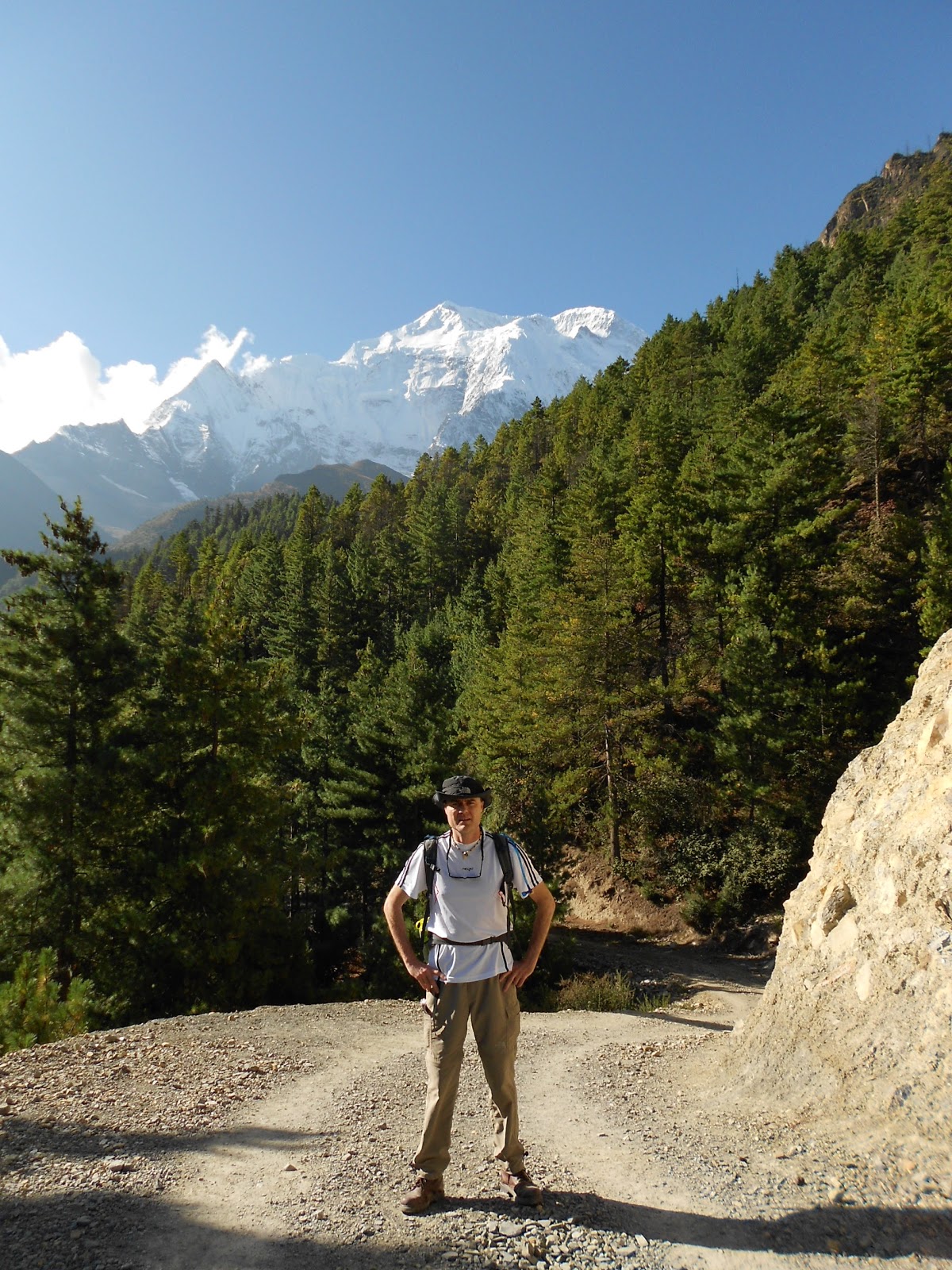
At the end of the second day, we were forced to overnight in a place called Koto.  We’d been aiming for Chame but were simply too exhausted to walk the last few kilometres.  Martin’s knee was swollen to nearly twice its usual size and the ladies were pretty worked too.  We spent the next hour lancing blisters and applying methylate, massaging swollen ankles and letting the life return to weary limbs.  But perhaps the best therapy came from the very hills that had doled out such punishment.  As I emerged from the shower, I was stopped dead in my tracks by the most awe-inspiring vista.  In the foreground, was an apple orchard whose trees bore a rich harvest of juicy red fruit.  High above it, the sun’s last rays had caught the summits of Annapurna II, (7937 metres), Annapurna IV (7525 metres) and the Lamjung Himal (6983 metres).  An hour later, a full moon rose gracefully above the peaks and the mountains pulsated incandescently in the ghostly light.  It was my first real view of the Himalaya I had travelled so far to see.  

That view will remain with me forever.

Annapurna II and the Lamjung Himal at dusk