Showing posts with label Thorung La. Show all posts

Friday, 26 October 2012

The Thorung La

Though 5416 metres above sea level, the Thorung Pass is sill about 400 metres lower than Kilimanjaro.  In spite of this the climb has its unique challenges, the biggest of which is the profusion of “false summits” that play havoc on the trekker’s morale.  The stone halfway house one encounters at dawn for example, looks very much like the structure at the summit though it is still several hours shy of it.   In addition, the undulating hillocks and saddles are so shapeless and void of definition that one can easily become disoriented.  Indeed, I have only dreamlike memories of that morning. 

In an attempt to assess ideal fitness requirements for this leg of the circuit, I had spent hours sifting through online reports and blog postings of people who had done it.  Much like the endless speculations that circulated on how to deal with altitude, I found there was no consensus on the toughness of the climb or just how much physical training was required for it.  Some younger, fitter trekkers minimised the physical demands while others – lulled into a false sense of security by their fitness levels - had gone too fast and found the day torrid.  Older trekkers had a more sober-minded approach and while they made no bones about the toughness of both climb and subsequent descent, they at least made it sound possible.  With hindsight (but with plenty of training behind me), I would describe the traverse of the Thorung La as challenging but fun.

A 3/4 moon hung high in the western sky as we fell into the shuffling procession of trekkers heading up the pass.  There was none of the cheerful banter that characterized the previous mornings, instead only laboured breathing and the squeak of boots on powdery snow.  The moon cast just enough light to pick up the faint outlines of the neighbouring peaks but to stay on track the use of a headlamp was essential.  When I stopped at the top of the first rise to look back, the bobbing line of tiny lights looked like a giant Christmas decoration on the move.  This was the first time in days that our team walked as a unit, checking on and encouraging one another, each reminding the other to drink.

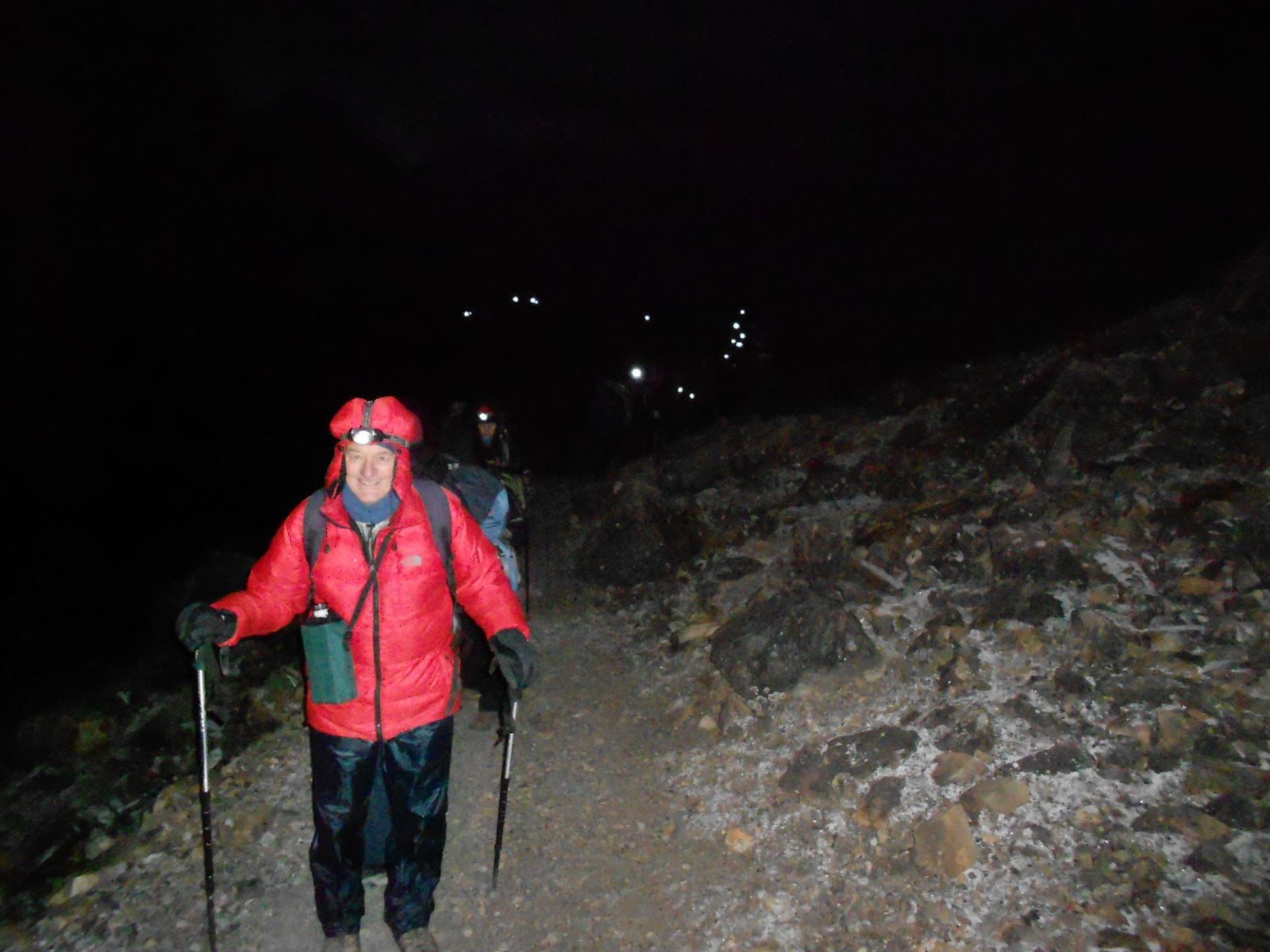
The smiles didn't last much beyond sunrise!

Memories of the four-hour climb, such as they were in that shapeless moonscape, have collapsed into a vague though heady collection of highlights: golden clouds boiling up darkened valleys, coppery mountain peaks penetrating the milky predawn darkness, desolate boulder strewn draws encrusted with snow.  Two hours out from High Camp, the procession had fragmented somewhat and for extended periods, we walked in solitude.


Soon however, our slow and fairly deliberate pace seeded us with a number of trekkers that were more or less in our age group or fitness level.  Most were struggling but were philosophical enough to know that the strain could be leavened by a liberal dose of humour.  Occasionally we would encounter someone who was clearly suffering from mountain sickness.  One such person was a Chinese lady who had become separated from her husband and who was staggering upwards, heavily burdened with camera equipment.  Possibly because of the language barrier but maybe because of delirium, she was impervious to our encouragements to rest and drink.  One got a slight insight into the heart-rending dilemmas faced by climbers in the Death Zone who can do little or nothing for ailing comrades.  While I would never say that 5400 metres warrants an “every man for himself” attitude, helping a sick person without compromising one’s own chances would have been very difficult indeed.  Mercifully, the Chinese lady prevailed and seemed to be doing fine by the time we reached the summit. 

One person who wasn’t doing well was Sandra.  By now she was quite unresponsive though complained periodically about a cracking headache.  At one point, on hearing that the summit was still two hours away, she had sat down in the snow and wept with frustration.  Thus, when we reached the summit at about 9am, we resolved to make our stay as brief as possible.  

There was a certain elation associated with getting to the top…countless photos were taken interspersed with plenty of high-fiving.  Afterwards, we crammed into a small stone house for a hot cup of tea.  Judging from the number of customers, I imagined the owner was making a small fortune from this venture.   But the place was so crowded, the smell of gas so overwhelming, I made a claustrophobic dash for the door.  It was pretty cold outside: twenty minutes later when we were getting ready to leave, I discovered that the pipe of my Camelbak had frozen solid.  We also discovered to our horror that someone had stolen Martin’s trekking poles, a disaster considering that the worst part of the route still lay ahead of us.  In light of Martin’s knee injury, the implication was that one of us would have to surrender our own poles.  As the crowd of summiteers thinned out however, it appeared it wasn’t a case of theft after all but rather one of mistaken identity.  We took a seemingly unclaimed set and after checking that the owner was nowhere, appropriated them.  This was a huge mercy – without them the walk down would have been close to impossible.

The summit at last - from left Rissam, Ram, me, Raj - kneeling is Kisna

I started this piece claiming that traversing the Thorung La was “challenging but fun”.  As we began our descent, it quickly became clear that the fun part was behind us.  While blogs described the descent as tough, many were quick to point out that it was a lot better than negotiating the pass in a clockwise direction i.e. from Muktinath to Thorung Phedi.  Only two categories of people, it seems, do this – local traders on horseback and the certifiably insane.  One reason is the absence of any suitable lodgings so acclimatization is nearly impossible.  Another reason is the unrelenting steepness of the path.  If the descent seemed endless, I shudder to think what the 1500m ascent might be like.

A look back up the trail
Buoyed up by the euphoria of having reached the summit, we began the walk down in a cheerful mood.  It wasn’t until midday however that the desperate nature of the retreat began to dawn on us!  Though the snow gradually thinned out and the pathway became less slippery, the steepness intensified.  We took a rest on a remote pasture, a brief “landing” in the unending staircase of switchbacks.  From this vantage point, we looked down into the arid swathe of the Kali Gandaki Valley, to Muktinath and Kagbeni, gateway to the fabled region of Mustang.  In the distance stood the imposing bulk of Dhaulagiri, the world’s 7th highest mountain.  

Our destination still seemed miles away.  And though we’d descended at least 900 metres, the dangers of altitude had not diminished in the least.  High on the path above the meadow, I watched Lil staggering downwards, retching uncontrollably, clutching her head and complaining that she must have caught a bug.  Had we been more attentive to the talk on AMS at Manang, we would have known that many cases of altitude sickness present several hours after leaving the summit.  Also, we would not have lingered in this exposed position.  Ignorantly however, we sat around for nearly an hour trying to get Lil to swallow Super C’s and headache tablets.  Imagining that he would be welcome the money, we asked a passing horseman if he would escort her down on his pony.  Strangely he was hesitant – the path was too steep and either she would fall or the horse would stumble and hurt itself.  Instead, the man opened his bag and produced a bread roll.  “Perhaps if she eats she will feel better”, he said in Nepali.  We declined but were touched by the simple gesture.  With Martin, Sandra and Lil on the brink of exhaustion, we redistributed their packs between the three of us and resumed the bone jarring descent, stopping only to eat at a grimy establishment in Charabu.  A photo taken there shows the sorry and mostly humourless state of the team.

This section of the descent was probably the toughest - the path was surfaced with stones the size (and shape!) of a rugby ball and played havoc on the ankles

A humourless lunch at Charabu

By now I was impatient with our slow progress and itching for a hot shower.  After lunch I shouldered the packs and powered down the slopes.  As I approached a suspension bridge over the Thorung River, I saw Ram, Rissam and Kisna moving up the slope towards me.  Earlier that day, they had rushed on to Muktinath to secure hotel rooms.  Now, freshly showered and dressed in casual clothes and flip-flops, they were retracing their steps to help us down the mountain.  It must have been a tough day for them too but they were showing none of the outward signs.  A half hour later I was luxuriating in a hot shower at the North Pole Hotel in the sacred town of Muktinath, a sublime relief after 5 days of not bathing.  Two hours later, the rest of the team limped down the high street – shaky but in fairly good spirits.

Martin and Lil limp into Muktinath, sans luggage

That night, we celebrated the crossing over a meal of sizzling Yak steak and a shot of the region’s famous apple brandy, served hot alongside a cup of ginger tea.  It was a memorable end to an even more memorable day.  In truth, it was a half-hearted celebration.  The pass had taken its toll and it was doubtful we could proceed with the journey as planned.

Wednesday, 24 October 2012

Rest Day in Manang

We were entering what I consider with hindsight to be the most photogenic crescent of the Annapurna Circuit.  What struck me was not only the sheer diversity of the subject matter but the density of it too - strange and fantastical geological formations, wooded valleys of blue pine and juniper, serene meadows, artisanal wooden bridges spanning rushing rivers.  All this scenic generosity juxtaposed against cobalt blue skies and boiling phalanxes of cloud made the memory of our third day one I will treasure for a long time to come.  


Trekking near the Swargadwari Danda - the photos hardly do this place justice

At the epicenter of this marvelous region was the village of Dhikur Phokhari, immediately recognizable for the gigantic sweep of the Swargadwari Danda – a severe rock face which towers over the town.  It resembled a gargantuan tidal wave which aeons ago was on the verge of pulverizing the valley before the creator uttered the words “this far and no further”.  The 1500 high metre wall was visible for the majority of the walk from Koto to lower Pisang though some of the best views could be seen from the road that meandered through the forest beyond the town.

The day would have been perfect except for the fact that I had a pounding headache by the time we reached Pisang, 3200 metres above sea level.  I made a mental note to escalate my water intake and to commence my course of Diamox that very night.  After checking into the guesthouse, I followed the trail out of town to get a better view of the sunset.  I stood for a while and examined a primitive yet fully functioning aqueduct fashioned from hollowed out pine logs.  It was brimming with fresh water diverted from the river higher up the trail and though ancient was undeniably elegant in its simplicity.  I crossed the river and scrambled up the hill.  On the crest stood a memorial to an ill-fated Japanese expedition that had perished some years ago on the slopes of Annapurna IV.  High above the forest, the peak in question luxuriated in a glorious burst of alpenglow – almost too beautiful to be dangerous.


Dusk outside Pisang

That evening in the dining hall, it was obvious that I wasn’t the only one concerned about the effects of altitude.  Indeed, the higher we got the more fixated about it we became.  We were unanimous that the trail had been harder than anticipated and keenly aware that our progress had been painfully slow.  Stretches which should have taken 6 hours or less to complete were taking 8 hours or more.  But it wasn’t until Raj said that we would need more days to successfully negotiate the Thorung La that things really got really heated.  Some lamented the obvious implications: the trip to Annapurna Base Camp would either be an unpleasant rush or even impossible.  After much debate on how to reset our itinerary, we agreed not to re-visit the issue until our rest day in Manang.  Of one thing we were all agreed however: no one wanted to retrace the trail to Sangye.  There would be only one way and that was up.


The following day, the walk through to Manang was one of the most relaxing we had had to date though conditions were very dusty and the glare off the road’s clay surface intense.  Much as I enjoyed the day, I was irritated to discover when it was too late that there were two routes to Manang and that our guide, assuming we weren’t fit enough for the higher more scenic one, had remained silent on the issue and defaulted us to the tamer route.  It was a Swedish Doctor we met near Humde who let the cat out of the bag, expressing amazement at our choice.  Though she didn’t elaborate, we knew we’d drawn the short straw.  Still, had it not been for this, we would not have been in a position to sample the baked delights of the Humde and Manang valleys where the locals have developed quite an expertise in the fine art of patisserie.  At Humde airstrip we purchased cinnamon buns from an old lady by the roadside and at Braga sampled freshly baked carrot cake.  These items were surprisingly good and a welcome break from the artificially sweetened biscuits that up to now had accompanied our tea breaks.

The Humde Valley - the airstrip is temporarily out of action as they are tarring it - (probably bad news because it will mean more flights and thus more tourists)

Making friends in the Humde Valley


 We arrived in Manang shortly after lunch.  At 3500 metres, the town is a good place to spend a rest day and most trekkers spend two nights there.  Because of this, Manang is a good deal more cosmopolitan than other places we’d stayed.  The cobbled streets are lined with souvenir shops, outdoor stores, book exchanges and a few very good coffee shops and bakeries selling such brands as illy and Lavazza.  The town even has its own movie house that constantly loops the same 6 films.  They are:

“Into the Wild” and “Into Thin Air” (inspired by the John Krakauer books)  
The Nepalese art nouveau classic “Himalaya”, 
The gripping mountaineering docudrama “Touching the Void”, 
“Slum Dog Millinear” (sic) and 
“The Hangover” (of all films!).  


The movie house has its own fireplace, seats covered in Yak hide and guests are served fresh popcorn and hot tea.  It’s all a very nice touch indeed.  Manang is also the headquarters of the Himalayan Rescue Institute, housed in a ramshackle cottage at the entrance to the village.  Here, trekkers can attend free daily talks on mountain sickness and have their oxygen levels tested for $10 a pop.  We attended one such talk and found it both highly informative and entertaining – if not a little unnerving.  

After a good night’s sleep and the prospect of a full day’s rest, everyone was feeling a lot better.  I went shopping and bought trekking poles having neglected to get some in Khatmandu.  Eager to try them out, I convinced Raj and the others to join me on an acclimatizing walk up to Chongkor Point (3800 metres) on the other side of the river.  The point is at the summit of a massive hill that overlooks the Gangapurna Glacier and lake.  

Led by two of our porters, we set off just after breakfast.  The downhill section to the river led through Manang’s primitive stone town where the sanitation was gossamer to say the least.  I quickly named this septic area “poo alley”.  Fortunately the uphill section to Chongkor point was a lot easier than it looked from the other side of the valley and though the views of the glacier and the lake were spectacular, they were alloyed somewhat by the prospect of the descent.  No one was looking forward to a knee pounding – or to the miasmic sludge of “poo alley”.   But in the event we coped just fine.  

Technology comes to the Annapurna Region

Gangapurna Glacier

Amongst Manang’s many acclimatization walks is an excursion to a monastery situated on a barren hillside 800 metres above the village.  The place dates back to mediaeval times and is inhabited by a Buddhist Lama who for the sum of 200 rupees will impart a blessing to his visitors.  A fellow trekker who went there told me that the Lama is 94 years old and that he last came down to Manang more than 30 years ago.  He is attended by his 64 year old daughter who descends to the town once a week to purchase food and other supplies.

The rest day did me good and and though Manang was a bit on the busy side and our hotel a little too grubby for my liking, I found the valley enchanting.  In the rarefied air, the mountains seemed so close you could reach out and run your hand along their icy slopes.  I was also taken by the industriousness of its people and the “all hands on deck” urgency they brought to harvesting the ripened wheat crop.  From before sun up to well after dusk, people of all ages pressed into the challenge associated with cutting, bundling, carrying and threshing.  I suppose the spectacle should have inspired a sermon on Matthew chapter 9!  

The only concern was Sandra’s condition.  Her flu had actually gotten worse in spite of her day’s rest.  Surprisingly, a British doctor form the Himalayan Rescue Institute had given her the all clear to ascend, providing she did so slowly.  Our decision regarding itinerary had practically been made for us.  Our next overnight stop would be Yak Kharka, 400 metres higher than Manang.

The beautiful Manang Valley


Friday, 19 October 2012

Yak Kharka Village, 4050m – Day 7

I shoveled the last few spoonfuls of porridge into my mouth and took a sip of water to wash down a cocktail of multi-vitamins and half the daily dose of the mountain sickness drug Diamox.

“It’s time we made a start,” I said to Martin, looking at clock on the wall behind me.  “We can’t wait for the others”

“You can start but move slowly,” said Raj the guide.  “I will wait for the others and we’ll catch up with you in Ledar - but wait for us there” 

We shouldered our packs, made a few adjustments to our trekking poles and gazed up the street towards the trail, still heavily shrouded in mist and the shadows of the surrounding peaks.

Though this was supposed to be one of the high points of our journey I felt despondent and a bit anxious.

For one thing, it was considerably colder this morning than it had been in Manang, the town one day’s walk behind us in which we’d spent two nights and enjoyed a full rest day.  For another, though there’d been enough water for a shower, none of it was hot enough to bathe in and it would likely be days before we smelled decent again.  

Moreover, neither Martin nor I had slept well, each complaining that the other had snored.  A mouse had found it’s way into my bag and had spent the night gorging itself on a packet of Future Life cereal.  

I felt a bit lonely too I suppose.  Late the previous afternoon, Sander – a Dutch traveller with whom I’d gotten pretty friendly during the last 5 days - had raced through Yak Kharka with his talkative guide Tilak saying he needed to make more ground before nightfall.  The last time we’d chatted was over tea earlier that morning on the roof of a spectacular mountain facing tea shop in Ledar.  Sander was now headed for the higher reaches of the trail at either Thorung Pedi or Thorung High Camp.  I thought he was silly but, with hindsight, it was a slight feeling of sadness in seeing him go.  I waved a friendly goodbye nonetheless.  It would be the last time we’d see him on the Circuit.

As Martin and I headed out of Yak Kharka (Nepalese for “the Yak Meadow”) – I looked down at a stone-walled field where the previous day, a Brazilian named Andre and I had gone to get a photograph of a magnificent jet black Yak bull.  Andre had come to Nepal hoping to walk to Everest Base Camp but, after the Lukla bound plane went down the previous Friday killing all 19 people aboard, authorities had closed the flight paths into the Everest region indefinitely and he was forced to change his plans.  At the last moment, the Brazilian fell in with a trio of Israeli youngsters who had just completed their military service and were looking to stretch their legs beyond the borders of their troubled homeland.  

The Yak in situ promised to be the perfect shot – a mountain backdrop complete with iconic Himalayan beast of burden in the foreground.  All went smoothly until Andre decided that the best way to get a head-on view of the beast was to pelt it with stones.  Oh Andre got his picture all right…but things rapidly deteriorated from there.  Reflecting on the event later, Andre would say that anything was better than wasting time with his Israeli companions who he said only wanted to sleep, play cards and smoke the hookah.


To cheer myself up, I plugged in my earphones and listened to Matt Redman’s “10 000 Reasons” from start to finish.  The words seemed all the more significant out here in this exposed environment.  For a while I walked in a contemplative bubble, focusing only on the lyrics and on the hypnotic rise and fall of Martin’s boots.  

But the cold and shadows persisted, a reminder of the heights to which we had already come and the 1500 meters we still had to ascend if we were to successfully cross the Thorung La.  

Not for the first time I felt a rising tide of guilt.  Our initial itinerary had us flying into Jomsom (2700m) and taking a leisurely (and tamer) trek downhill, turning off at Birethanti to visit Annapurna Base Camp.  Several weeks before leaving however, I’d heard from various sources that this side of the circuit had been heavily compromised by a new road and besides, was not nearly as scenically impressive as the northern sector.  I’d thus pushed most heavily (and successfully) for a switch of itineraries that would skim the cream off the circuit - the leg from Besi Sahar to Jomsom followed by a bus trip to Birethanti where we would turn off and spend the last 6 days climbing to Annapurna Base Camp. 

I’d naively overlooked the fact that the northern sector is the far tougher and more isolated sector.  I’d minimized the effects of the altitude and physical demands of crossing the Thorung La (at 5400 m, nearly as high as Kilimanjaro).  I’d made light of the fact that Martin was not only too old to get special insurance cover for this journey (he is 74) but that he’d had knee surgery just 3 months before coming.  (In fact martin only made his final decision to come 9 days before we travelled).  In reality, though a veteran of 7 Kilimanjaro ascents and a trek to Everest Base Camp 4 years ago, this was always going to be a tough outing for him – a week earlier I’d watched him limp uncomfortably onto the plane in Durban and wondered how he’d ever get through the next 21 days in one piece.  

Then there was the fact that few members of our team had ever climbed under their own steam to 3000 metres and that few had done any serious strength training for the walk.  

Lastly, there was Sandra who had been battling with flu symptoms and a pounding headache for nearly 3 days.  In the face of overwhelming evidence to the contrary, a British doctor in Manang had given her the all clear to move up the trail provided she did so slowly.  

The guilt had first surfaced 3 days earlier in Pisang but had intensified as we climbed higher.  Now as we moved deeper into the shadows of the great Thorung and Chulu Peaks, it threatened to overwhelm.

As I packed away the iPod, a familiar pins and needles sensation returned to my toes and fingers, a condition the locals refer to as the Djhum Djhums.   They were a side effect of the Diamox pill I’d taken an hour or so earlier.  While a completely harmless sensation, it was intense enough to be un-nerving.  

I’d read in Lonely Planet that reports of high altitude sickness on the Thorung La were “greatly exaggerated” and that the majority of people successfully avoided it (or at least experience only mild symptoms).  While this may be so, the fact remained that Acute Mountain Sickness (AMS) was affecting people all around us.  In the past few days we had passed a number of patients being rushed to lower altitudes on horseback, clinging for dear life to either mane or saddle while a tribesman ran alongside, $120 the richer for his exertions.  Daily helicopter sorties hinted at more serious cases.  A talk by a world expert on AMS named “Dr Tom” at the Ramshackle Himalayan Rescue Institute in Manang had highlighted the risks, clarified the symptoms and scared most people witless.

As a team we were nothing if not careful - surely we’d be fine?